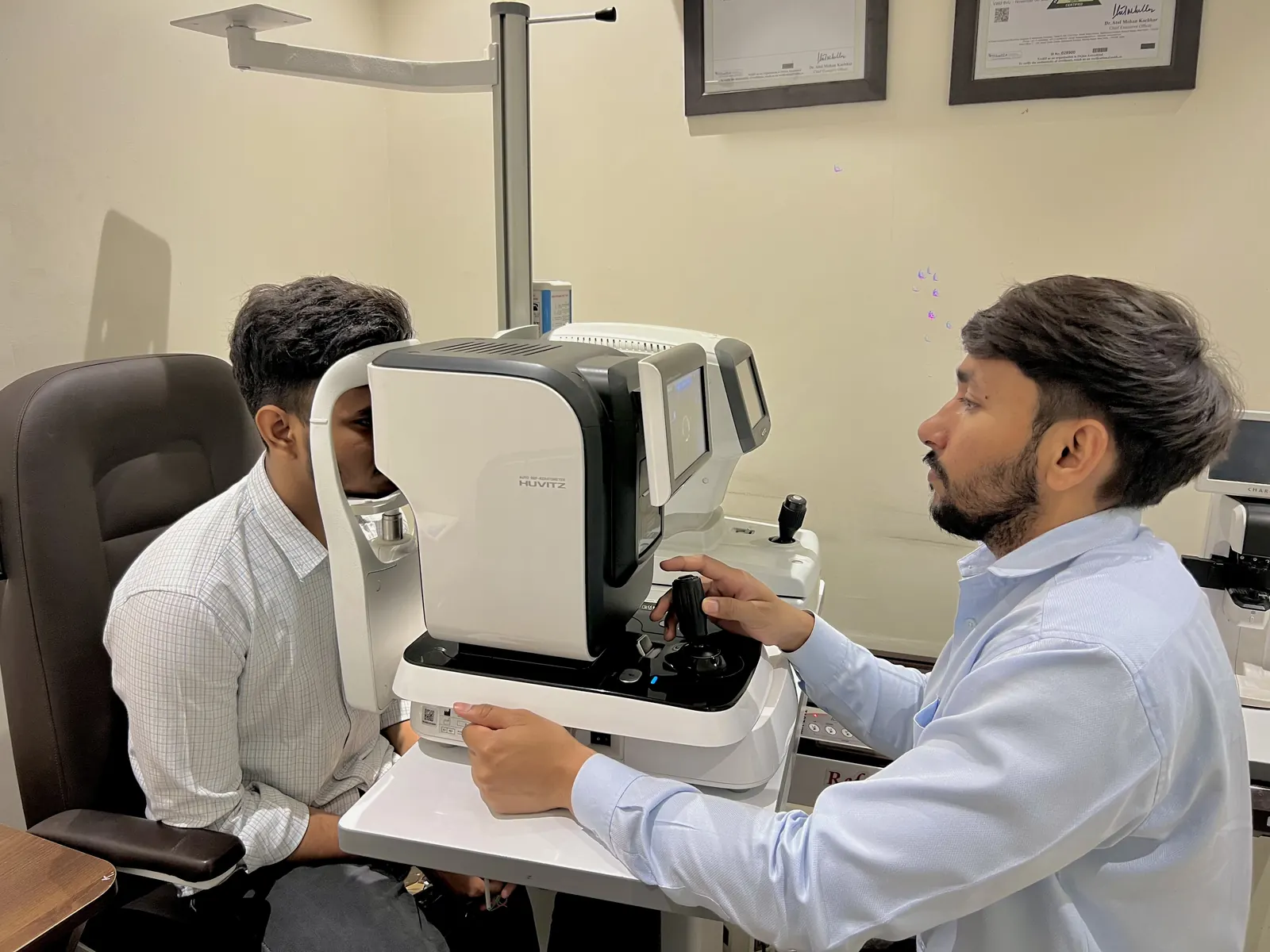
Myopia in Children: Symptoms, Causes, Treatment and Ways to Control Nearsightedness
Is your child sitting too close to the television or holding books very close to their eyes? Does your child complain that they cannot see the classroom board clearly?
These could be early signs of Myopia, commonly known as Nearsightedness or Minus Number.
Myopia is a common vision condition in children in which distant objects appear blurred while nearby objects can usually be seen clearly. It often develops during childhood and may progress as children grow.
With increasing screen use, reduced outdoor activities and changing lifestyle habits, childhood myopia has become an important eye health concern.
At Gandhi Eye Centre, Faridabad, we believe that early eye examinations and regular monitoring can help protect children's vision.
What Is Myopia?
Myopia, also called Nearsightedness, is a refractive error in which a child can see nearby objects clearly but distant objects appear blurred.
It usually occurs when the eyeball grows longer than normal or when the cornea has excessive curvature. As a result, light focuses in front of the retina instead of directly on it.
Myopia can develop during childhood and may gradually increase as the child grows.
What Are the Symptoms of Myopia in Children?
Children may not always understand or communicate that they have a vision problem.
Parents should watch for these common symptoms:
Difficulty seeing the classroom board.
Sitting very close to the television.
Holding books or mobile phones very close to the face.
Frequent squinting while looking at distant objects.
Complaints of headaches or eye strain.
Difficulty recognising distant objects.
Poor performance in activities requiring distance vision.
If you notice these signs, schedule a comprehensive eye examination for your child.
What Causes Myopia in Children?
Myopia can develop due to a combination of genetic and environmental factors.
Common contributing factors include:
1. Family History
Children whose parents have myopia may have a higher risk of developing the condition.
2. Excessive Near Work
Spending long periods reading, studying or using digital devices at close distances may be associated with an increased risk of myopia.
3. Reduced Outdoor Activities
Children who spend less time outdoors may have a higher risk of developing myopia.
4. Increased Screen Time
Prolonged screen use can contribute to eye strain and may be associated with childhood myopia risk, particularly when it replaces outdoor activities.
What Are the Different Types of Myopia?
Myopia can be classified based on its severity and clinical characteristics.
1. Simple Myopia
This is common childhood nearsightedness in which distant objects appear blurred and vision can generally be corrected with spectacles or contact lenses.
2. Progressive Myopia
In this condition, the minus power continues to increase over time as the eyeball grows.
3. High Myopia
High myopia refers to a higher degree of nearsightedness, generally -6.00 diopters or more. It may increase the risk of certain retinal complications later in life.
Early monitoring is important to identify children whose myopia is progressing rapidly.
How Is Myopia Diagnosed in Children?
A comprehensive eye examination helps determine whether a child has myopia and how much correction is required.
Your eye specialist may recommend:
1. Visual Acuity Test
This test checks how clearly your child can see objects at different distances.
2. Refraction Test
This examination determines the correct spectacle power required to improve vision.
3. Cycloplegic Refraction
Special eye drops temporarily relax the focusing muscles to help obtain a more accurate spectacle power in children.
4. Axial Length Measurement
This test measures the length of the eyeball and can help monitor eye growth and myopia progression.
Regular examinations help your eye specialist track changes in your child's vision.
How Can Myopia Be Controlled in Children?
Although myopia cannot always be prevented, several management options may help slow its progression.
Treatment depends on the child's age, spectacle power and rate of progression.
1. Special Myopia Control Spectacles
Certain specially designed spectacle lenses may help slow myopia progression in children.
2. Myopia Control Contact Lenses
Certain specialised contact lenses, including dual-focus and multifocal designs, may help manage myopia progression under professional supervision.
3. Low-Dose Atropine Eye Drops
Low-dose atropine may be prescribed by an eye specialist to help slow the progression of myopia in selected children.
4. Increased Outdoor Activities
Encouraging children to spend approximately two hours outdoors daily, where practical, may help reduce the risk of developing myopia.
5. Regular Eye Check-ups
Regular monitoring allows the doctor to assess changes in spectacle power and eye growth and adjust the management plan when needed.
How Can Parents Protect Their Child's Eyes?
Parents play an important role in maintaining their children's eye health.
Follow these simple habits:
Encourage outdoor play every day.
Limit unnecessary recreational screen time.
Maintain a comfortable reading distance.
Ensure proper lighting while studying.
Encourage regular breaks during prolonged near work.
Avoid using mobile phones very close to the eyes.
Schedule regular children's eye examinations.
Remember, wearing spectacles does not make myopia worse. Correct spectacles help children see clearly, learn comfortably and participate in everyday activities.
Can Myopia Cause Serious Eye Problems?
Most children with ordinary myopia can manage their vision with appropriate correction.
However, high myopia can increase the risk of certain eye conditions, including:
Retinal detachment.
Myopic macular degeneration.
Glaucoma.
Early cataract.
This is why monitoring myopia progression during childhood is important.
Myopia Evaluation and Children's Eye Care at Gandhi Eye Centre, Faridabad
At Gandhi Eye Centre, Faridabad, we understand the importance of healthy vision during childhood.
Under the guidance of Dr. Deepak Gandhi, children can undergo comprehensive eye examinations to identify refractive errors and other vision-related problems.
Our focus is on early detection, accurate spectacle correction and appropriate recommendations for monitoring childhood myopia.
We encourage parents not to ignore signs of blurred distance vision in their children.
Frequently Asked Questions (FAQs)
1. At what age can children develop myopia?
Myopia commonly develops during school-going years, although it can occur earlier. Early eye examinations help identify vision problems.
2. Can myopia be cured permanently?
There is currently no guaranteed permanent cure for childhood myopia. However, appropriate correction helps improve vision, while myopia control treatments may slow its progression.
3. Does mobile phone use cause myopia?
Prolonged near work and excessive recreational screen use may be associated with increased myopia risk. Balancing screen time with outdoor activities is important.
4. Can myopia increase as children grow?
Yes. Myopia often progresses during childhood and adolescence as the eyeball continues to grow.
5. How much outdoor time should children get?
Encouraging approximately two hours of outdoor activity daily, where practical, may help reduce the risk of developing myopia.
6. Should children wear spectacles if they have myopia?
Yes. Children should wear the spectacles prescribed by their eye specialist to ensure clear vision.
7. How often should children get their eyes checked?
The frequency depends on the child's age, spectacle power and rate of myopia progression. Children with myopia may require follow-up examinations every 6–12 months or as advised by their ophthalmologist.
Book Your Child's Eye Examination Today
Your child's vision plays an important role in learning, reading, playing and overall development.
Do not ignore frequent squinting, blurred distance vision or difficulty seeing the classroom board.
Visit Gandhi Eye Centre, Faridabad, for a comprehensive children's eye examination.
Gandhi Eye Centre
Shop No. 118, 9-10 Dividing Road, Block G, Sector 9, Faridabad, Haryana – 121006.
Call: +91 98182 19196
Website: https://www.gandhieyecentre.com/
Healthy Eyes. Brighter Future. Protect Your Child's Vision.