Age-related macular degeneration (AMD) affects the macula, the part of the retina responsible for sharp central vision, and is a leading cause of vision changes in older adults.
What Is It?
AMD is a condition that affects the macula, causing gradual changes to central vision while typically sparing peripheral (side) vision. It usually affects people over 50 and becomes more common with age.
AMD is broadly classified as 'dry' (more common, gradual thinning of macular tissue) or 'wet' (less common but can progress faster, involving abnormal blood vessel growth under the retina).
Because AMD affects central vision, it can impact tasks like reading, recognising faces and driving, even when a person's overall (peripheral) vision remains functional.
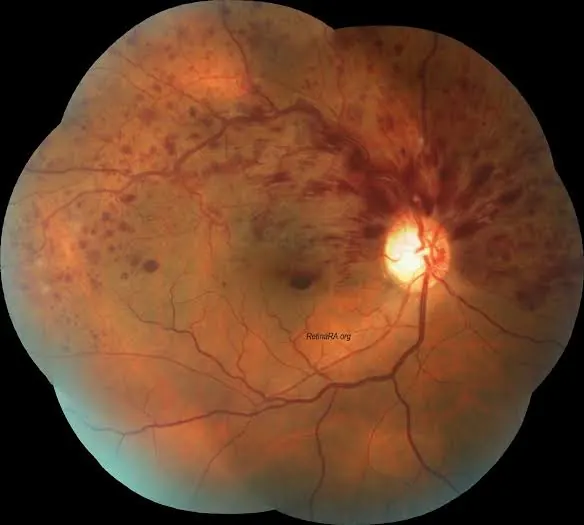
Symptoms & Indications
AMD symptoms usually develop gradually in the dry form, but can appear or worsen more quickly in the wet form.
Central vision becomes less sharp, making reading fine print or recognising faces at a distance more difficult.
Distorted, wavy or bent lines (tested with an Amsler grid) are a classic early sign, especially of wet AMD.
A blurred or blank area directly in the centre of vision, while side vision remains relatively clear.
Needing more light for reading or noticing slower adjustment when moving between light and dark environments.
Treatment Options
OCT scanning and other retinal imaging help identify whether AMD is present, and whether it is the dry or wet type.
For dry AMD, regular monitoring (including home Amsler grid checks) and lifestyle guidance are often the main approach.
Wet AMD may be treated with intravitreal injection therapy aimed at controlling abnormal blood vessel growth — assessed and discussed on a case-by-case basis.
What To Expect
Diagnosing and staging AMD relies on a combination of examination and imaging.
The macula is examined in detail after pupil dilation to look for early or advanced AMD changes.
OCT provides a detailed cross-section of the macula, helping distinguish dry from wet AMD and guide any treatment.
A simple grid test helps detect distortion in central vision, useful both for diagnosis and home self-monitoring.
Based on the type and stage found, a monitoring schedule or treatment plan (for wet AMD) is set.
Please note: AMD is generally a chronic, long-term condition managed over time rather than 'cured'. Sudden new distortion or vision loss in a patient with known AMD should be treated as urgent and reviewed promptly.
Common Questions
Evaluated and treated under Dr. Deepak Gandhi, Director of Gandhi Eye Centre, with clinical experience across cataract, glaucoma, cornea, retina and pediatric eye care.
View Doctor Profile →Book a macular evaluation at Gandhi Eye Centre, Faridabad, especially if you're over 50 or have noticed distorted central vision.